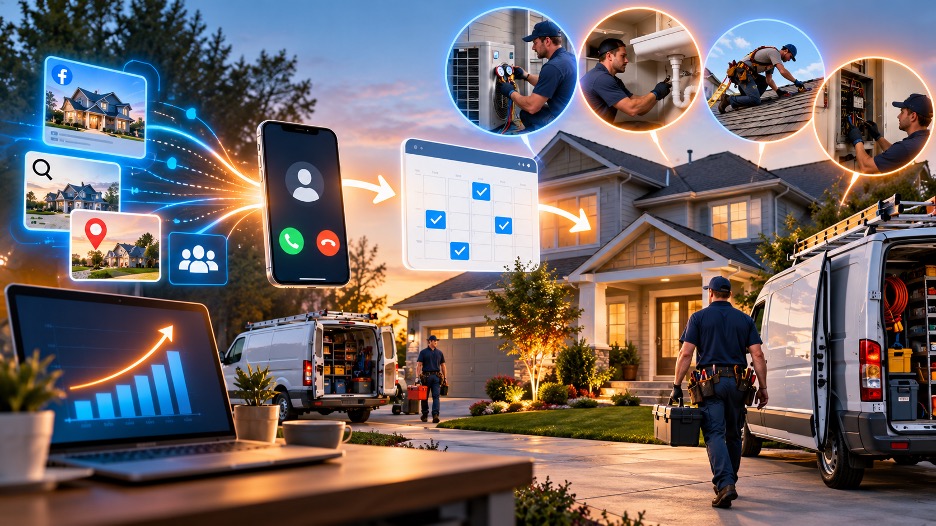
Most home services advertising gets judged on clicks, impressions and cost per lead. Your dispatch board doesn’t care about any of those. It cares about booked jobs.
A home services advertising strategy decides which marketing channels get your budget and how every dollar traces back to revenue in your CRM. This guide covers the channel mix, the advertising budget split and the measurement layer ESB Advertising uses for HVAC, plumbing, roofing and electrical companies.
What Is an Advertising Strategy for Home Services Businesses?
An advertising strategy for home services businesses is a written plan for paid media: which channels run, what each one costs, which target audience it reaches and which metric proves it worked. Lists of marketing tips, marketing ideas and advertising ideas stop at tactics. A strategy sets priorities.
For an HVAC company in July, that means high-intent search ads that answer the phone during a heat wave. For the same home services company in April, it means streaming TV so homeowners remember the brand before the first breakdown.
Home Services Marketing vs. Advertising: Where Paid Media Fits
Home services marketing covers everything that brings in work: SEO, content marketing, social media marketing, reputation management, a referral program and plain word of mouth. Advertising is the paid slice of that marketing strategy. You buy placement on Google Ads, Local Services Ads, Facebook, YouTube, broadcast TV or radio, and you control when the message runs.
The two depend on each other. Paid ads send potential customers to your website and Google Business Profile, where online reviews and landing pages close the sale. A home services marketing agency plans both together for home service businesses. A strong ad pointing at a weak profile burns budget.
Home Services Industry Demand: Why HVAC, Plumbing and Roofing Differ
The home services industry runs on two kinds of demand. Emergency demand arrives as phone calls after a storm or a breakdown. Think burst pipes and dead furnaces. Planned demand builds over weeks as homeowners compare quotes for a new system or a full replacement.
Each trade weights them differently:
- Plumbing leans emergency, and most of those searches happen on mobile, so click-to-call ads and 24/7 call handling matter most.
- HVAC swings seasonal, with summer and winter peaks and quiet shoulder months.
- Roofing follows storms and long sales cycles, so retargeting and video carry more weight.
- Electrical contractors mix service calls with panel upgrades and EV charger installs.
Stop wasting advertising dollars on clicks. Build a strategy that delivers more booked jobs
Build Your Home Services Ad Strategy
Building a Home Services Marketing Strategy Around High-Intent Demand
High-intent demand is the homeowner who types “AC repair near me” at 9 p.m. That search is worth more than any banner impression, so a home services marketing strategy funds it first.
Three channels capture it: local SEO, Google search ads and email marketing to existing customers. Together they form the base layer of your home services marketing strategies. Awareness spending comes after.
Local SEO and Google Business Profile: Your Digital Marketing Foundation
Google Business Profile decides whether you appear in the Google Maps pack for local search. A complete profile lists your service area, hours, services and photos. Google names review count and score among its local ranking factors, so every finished job should trigger a review request.
Local SEO extends that reach into organic search results. Service pages for each trade and city, consistent listings on Yelp, Angi and Nextdoor, and keyword research built on how homeowners actually search all feed the same goal. SEO services take months to compound, which is why paid search runs alongside them from day one.
Home Services Ads on Google: PPC and Google Local Services Ads
Google Local Services Ads sit above every other result on the page. LSAs charge per lead rather than per click, carry the Google Guarantee badge and rank partly on reviews, responsiveness and proximity. For plumbing and HVAC companies, Google Local Services Ads management is often the fastest path to qualified leads.
Pay-per-click (PPC) fills the gaps LSAs leave. Google Ads and Microsoft Ads let you bid on exact services, write your own ad copy and run Performance Max across YouTube and display. Good PPC management cuts that first:
- Block irrelevant search terms and clicks from outside your service area.
- Split emergency campaigns from planned-service campaigns.
- Add call tracking so every call ties to a campaign.
- Send each ad group to its own landing page with online booking.
Email Marketing and SMS: Turning Past Jobs Into Repeat Customers
Your cheapest booked job comes from someone who already hired you. Email marketing and SMS reach existing customers cheaply. New customers from paid search cost far more. Tune-up reminders, maintenance plan renewals and review requests keep your brand top of mind and improve the customer experience.
ServiceTitan and Housecall Pro both store the first-party data these email campaigns need: equipment age, last visit and job value. Segment on that data. A ten-year-old furnace becomes a replacement lead before it fails.
Get a Free PPC Audit for Your Home Service Company
Expanding Your Marketing Channels Beyond Search
Search only reaches homeowners who already have a problem. The bigger audience hasn’t searched yet, and they’re the people who remember your name when the furnace quits.
An omnichannel plan adds video, broadcast and streaming to build that memory. ESB buys across 315+ media partners and has produced 1,738 commercials, including Super Bowl spots for home services clients. Creative and placement come from one team.
Streaming TV and Connected TV: Reaching Homeowners on Hulu, Roku and YouTube TV
Streaming TV puts a 30-second spot in front of homeowners on Hulu, Roku, YouTube TV, Paramount+ and Peacock. Connected TV and OTT inventory is bought through programmatic platforms, so you target by zip code and homeownership instead of an entire metro. An HVAC company can stop paying for households outside its service area.
Long Roofing shows how this works in practice. ESB shifted its focus from the 1% of viewers shopping for a roofer today to the 99% who will need a roof later, pairing the “talking shingles” TV campaign with OTT on Roku and other streaming devices. Long Roofing grew revenue 20% year over year.
Measurement separates useful CTV from expensive branding. Streaming TV advertising for home services should report website traffic, branded searches and phone calls from households that saw the ad. Completed views alone prove nothing.
When to Advertise on Broadcast TV, Radio and Direct Mail
Broadcast TV and radio deliver reach that digital marketing rarely matches in one buy. They earn their cost when you need brand awareness fast: entering a new market, launching a maintenance plan or recovering from a slow season. ESB plans these buys with Nielsen ratings, daypart analysis and post-log verification, so you pay for spots that actually aired.
Michael & Son, the DMV plumbing, electrical and HVAC contractor, runs this full mix with ESB as agency of record: broadcast, cable, radio, streaming TV, paid search and social across 8 markets. Its revenue nearly doubled between 2011 and 2019 while overall advertising costs fell 17%, and the company now tops $100 million a year.
Put your brand on homeowners’ favorite streaming platforms and build demand before competitors strike
Launch Your Streaming TV Campaign
How Home Services Companies Budget and Measure Return on Ad Spend
Home services companies lose the most money in two places: a budget split by habit, and reporting that stops at the lead. Fix both and the same spend produces more booked jobs.
Splitting Your Advertising Budget Between High-Intent Search and Seasonal Demand
Start your marketing budget with high-intent channels. LSAs, PPC and local SEO produce leads this week. Once cost per lead stabilizes, move a share of spend into awareness and retargeting, timed to your seasonal peaks.
A workable split for an established home service business looks like this:
- Search and LSAs: The largest share, raised during peak months.
- Paid social on Facebook, Instagram and TikTok: A smaller share for retargeting site visitors.
- Streaming TV or radio: A fixed awareness share in the 6 to 8 weeks before each peak.
- Retention through email and SMS: The smallest line item.
The right percentages depend on your market and your competitors. How much OTT advertising costs shapes the awareness line most.
Cost Per Lead vs. Cost Per Booked Job: The Metric That Matters
Cost per lead tells you what a phone call costs. Cost per booked job tells you what a paying customer costs. Agencies hide in the gap between them, because a cheap lead from a price shopper still looks good in a lead report.
Judge every channel on cost per booked job, customer acquisition cost and return on ad spend. The most important marketing metrics all track conversions that reach your bank account.
Mackdata Multi-Touch Attribution With ServiceTitan and Housecall Pro
Mackdata, ESB Advertising’s CRM- connected attribution software, connects ad spend to revenue through ServiceTitan, Housecall Pro, HubSpot and Salesforce. Its multi-touch attribution tracks every customer interaction, from Google Ads and streaming TV to booked jobs.
AI Call Tracking scores calls and analyzes sentiment to identify high-converting campaigns. Mackdata optimizes bids toward revenue-generating keywords and creative, while attribution and analytics provide real-time visibility into campaign performance, booked jobs and ROI across your marketing channels.
Book a Mackdata Demo for Your Home Service Business
Putting Your Marketing Plan Into Action
A marketing plan only works if it launches in order. Home service marketing fails most often when every channel switches on at once and nobody can tell which one worked. Sequence the rollout and add channels only when the last one is measurable.
A 90-Day Checklist for Launching Marketing Campaigns That Track Results
Use this rollout for the first quarter of a new home services advertising strategy:
- Days 1 to 30: Connect your CRM, set up call tracking and Google Analytics, and clean up your Google Business Profile.
- Days 31 to 60: Launch LSAs and PPC on emergency services, then run A/B testing on ad copy and landing pages to lift conversion rates.
- Days 61 to 90: Add retargeting and one awareness channel, such as streaming TV or radio, in your strongest market.
- Day 90: Compare cost per booked job by channel and move budget to the winners.
Social media ads and video marketing can wait. Add them once the core channels generate leads at a profitable cost. ESB runs this process with no long-term contracts, so the plan earns its renewal every month.
Schedule Your Free Home Services Ad Strategy Consultation
Ready to turn more ad clicks into booked jobs? Schedule a free consultation with ESB Advertising to review your current campaigns, identify wasted ad spend, and discover data-driven strategies that generate qualified leads, increase bookings, and maximize marketing ROI.
